What is running cadence?
Cadence is the number of steps you take each minute, counting both feet. If your watch shows 160 steps per minute, that is roughly 80 contacts from each foot.
You can take more steps without running faster. At the same pace, a higher cadence means each step covers less ground. A lower cadence means each step covers more.
That makes cadence one way to adjust how you run. It is worth understanding before trying to change a number on your watch.
| Same pace: 6:00 per km | Steps per minute | Average distance per step |
|---|---|---|
| Example A | 160 | 1.04 m |
| Example B | 168 (+5%) | 0.99 m |
Same speed. A different way to move.
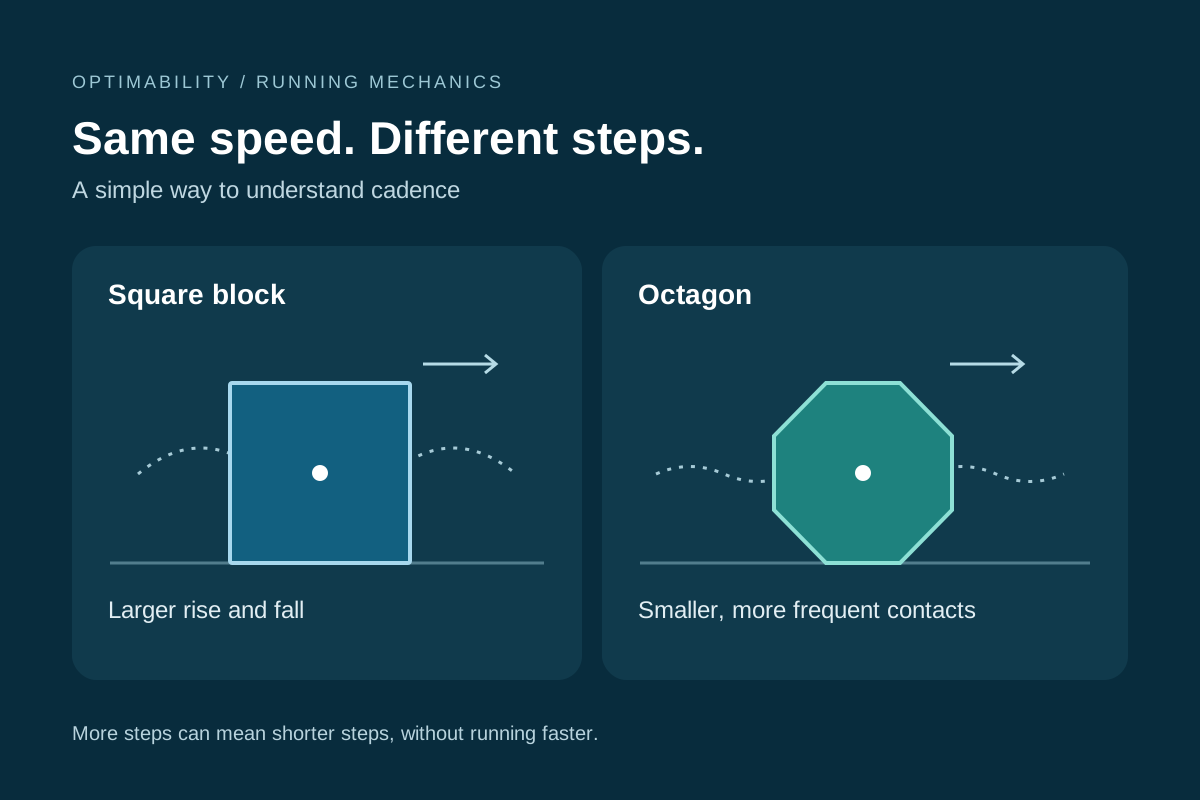
Picture two people moving along a flat path at the same speed. One tips a square block forward, edge by edge. The other rolls an octagon, a shape with eight sides.
The block has to rise farther before it tips onto its next face. The octagon makes smaller, more frequent contacts, with less rise and fall. Move both shapes below and follow the dot at each center.
This is a way to picture step spacing and vertical motion. A runner has joints, muscles, and tendons that absorb and return energy. These rigid shapes cannot tell us a runner's impact force or injury risk.
Two shapes. One forward speed.
Drag the slider. Both centers travel the same distance.
Square block
4 sidesFarther between contacts. More rise and fall.
Octagon
8 sidesCloser contacts. Less rise and fall.
What can a small cadence change do?
In a study of 45 recreational runners, researchers held running speed steady and changed step rate. Raising it by 5% or 10% reduced step length, the rise and fall of the body's center, and braking impulse, the backward push that slows you on landing.
The knee absorbed less mechanical energy at both increases. The hip did so at the 10% increase. These are useful findings about load during a run. They do not mean every impact measure drops, or that more steps will make every runner faster.
Does higher cadence prevent injuries?
We cannot promise that. A 2022 review found clearer evidence for changes in running mechanics than for lasting gains in performance or fewer injuries. Limited studies suggest some runners with pain around the kneecap may benefit from a higher step rate.
An injury also depends on the work your tissues can handle. A sudden jump in mileage, poor recovery, or an existing problem still matters. Cadence may be one part of a plan chosen with a physiotherapist or other qualified clinician.
Why 180 is not a target for everyone
Your pace, build, terrain, and habits all affect your step rate. Comparing an easy jog with someone else's race pace tells you little. Start with your own cadence during a steady run on familiar, flat ground.
If you are comfortable and running well, a lower number alone is not a problem to fix. A useful change should serve a reason, such as a clinician's plan for knee pain, and still feel manageable.
How to explore a small change
If you are running comfortably and want to understand the feel, use a brief trial within an easy run. This is a learning exercise, not an injury treatment plan. If you have pain, get guidance before changing your gait.
- Warm up, then note your usual cadence at a steady, easy pace. Count all foot contacts for 60 seconds, or check your watch.
- Try about 5% more steps for 30 to 60 seconds. A baseline of 160 becomes 168. Keep the same speed and let each step get slightly shorter.
- Return to your usual rhythm for a few minutes. You can use a metronome for the short trial; match one beat to each foot contact.
- Notice breathing, comfort, and any new strain. You do not need to change your foot strike or force yourself onto your toes.
- Stop if pain appears or worsens. Check how you feel later and the next day before considering more time at the new rhythm.
Put cadence in the context of your training
At Optimability, we look at what you are training for and what you can recover from. Your weekly running load and how you feel belong beside any watch metric.
Compare similar runs at the same pace. If a change feels forced or creates new discomfort, review it instead of chasing a higher number. Persistent pain needs an assessment, not another adjustment from a blog.
Common questions
No. Speed depends on both cadence and step length. At the same speed, more steps per minute means less distance per step.
There is no single best number for every runner or every pace. Compare your own runs under similar conditions before deciding whether a change has a purpose.
Count each foot contact for a full minute while holding a steady pace. If you count only one foot, double the result. Repeat to check that the count is consistent.
Some runners may benefit, but knee pain has several possible causes. A clinician can assess your symptoms and decide whether changing cadence fits your recovery plan.
You do not need to force a forefoot landing. Cadence describes step frequency, not which part of your foot touches down first. Avoid making several gait changes at once.