Every movement spends ATP
Muscle contraction runs on adenosine triphosphate, usually shortened to ATP. When ATP loses a phosphate group, it releases energy the muscle can use. The supply stored inside muscle is small, so the body must rebuild ATP continuously while you move.
Three pathways handle that job: the phosphagen system, glycolysis, and oxidative phosphorylation. They differ in how quickly they can regenerate ATP, how long they can support the workload, and which fuels they use.
The fastest pathway has the smallest capacity. The pathway with the largest capacity takes longer to meet a sudden increase in demand. Performance depends on how well the systems share the work.
The three energy systems
These descriptions show what each pathway is best equipped to do. They are not countdown timers. A sprint has an aerobic contribution from the opening seconds, and a long run still uses phosphagen and glycolytic energy when the pace changes or the runner climbs a hill.
| System | Main route | Strength | Main limitation | Common demand |
|---|---|---|---|---|
| Phosphagen | Stored ATP and phosphocreatine | Highest rate of ATP supply | Small intramuscular stores | A jump, heavy lift, acceleration, or opening seconds of a sprint |
| Glycolytic | Breakdown of glucose or glycogen | Rapid ATP supply without waiting for oxidative metabolism | Limited capacity during very hard work | Hard efforts lasting tens of seconds and repeated high-output bouts |
| Oxidative | Carbohydrate and fat oxidation in mitochondria | Large capacity | Lower maximum rate and slower adjustment to sudden demand | Longer efforts and recovery between hard bouts |
Choose an activity
The aerobic system becomes increasingly important for recovery between sprints.
These proportions are illustrations, not measured values. Pace, fitness, exercise mode, and recovery change the contribution.
Phosphagen: immediate power
The phosphagen system uses phosphocreatine stored in muscle to donate a phosphate group to ADP and rapidly rebuild ATP. The reaction is short and direct, which makes it well suited to sudden, high-power work.
Its limitation is capacity. Phosphocreatine stores fall quickly during maximal exercise, so the contribution drops as the effort continues. Recovery between bouts matters because phosphocreatine resynthesis depends heavily on oxidative metabolism.
Aerobic fitness can influence repeated-sprint performance because a strong oxidative system helps restore the immediate system between efforts, even when the work itself looks anaerobic.
Glycolysis: fast energy from carbohydrate
Glycolysis breaks one glucose molecule into two pyruvate molecules in the cell’s cytoplasm. The pathway uses two ATP and produces four, leaving a net gain of two ATP. It supplies ATP faster than oxidative phosphorylation and can respond when demand rises sharply.
When glycolytic flux is high, pyruvate can be converted to lactate. That conversion helps regenerate NAD+, which allows glycolysis to keep running. Lactate is then moved between cells and tissues, where it can be oxidized for energy, used to make glucose, or act as a signal.
Lactate rises during hard exercise, but calling it a waste product or the direct cause of fatigue misses its role. Fatigue during high-output work involves several interacting changes, including phosphocreatine depletion, inorganic phosphate accumulation, ion shifts, and falling force production.
Oxidative metabolism: capacity and recovery
Oxidative phosphorylation takes place in mitochondria. Carbohydrate and fat can feed the process, and oxygen serves as the final electron acceptor. The pathway produces far more ATP from a glucose molecule than glycolysis alone, giving it the capacity to support longer work.
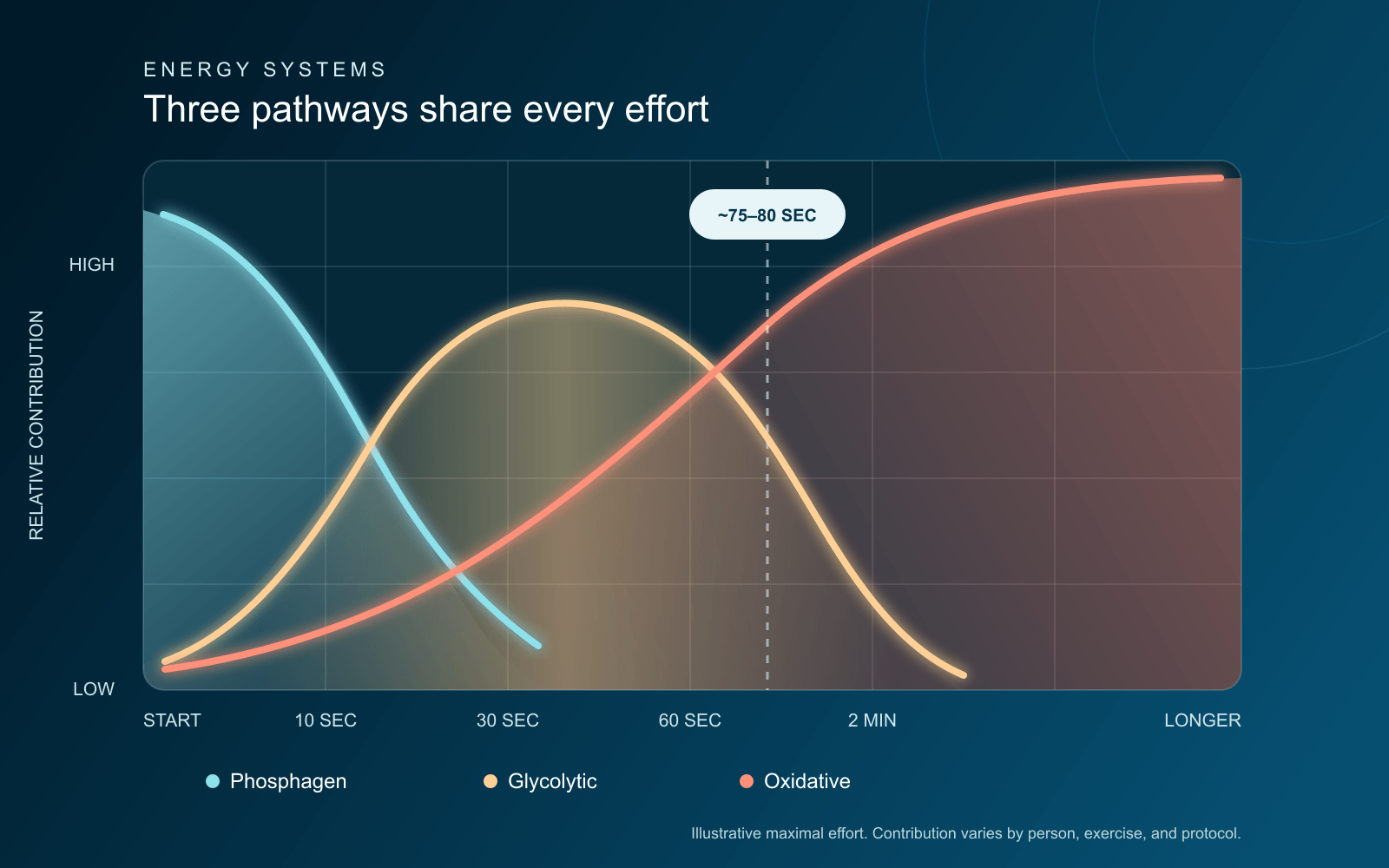
Oxidative metabolism also contributes earlier than many textbook diagrams suggest. During a maximal effort, its share rises quickly. Reviews place the crossover between combined anaerobic and aerobic predominance at roughly 75 to 80 seconds, although the exact point changes with the athlete, exercise mode, intensity, pacing, and the method used to estimate contribution.
Its job continues during recovery. Oxygen-dependent processes help restore phosphocreatine, metabolize lactate, and prepare the muscle for another bout.
All three systems work at once
The dominant contribution changes across an effort, but no system waits for another one to finish. Phosphagen supply rises immediately and falls quickly. Glycolysis ramps up as the effort continues. Oxidative contribution begins early and becomes the main supplier as duration increases.
The crossover shown in the graph is an illustration of maximal exercise, not a prescription or a universal clock. A trained cyclist, a recreational runner, and someone doing repeated sled pushes can show different curves.
Watch the contribution change
A conceptual maximal effort. All three systems contribute from the start, and the exact curve varies by person and protocol.
Train the demand, not the label
A conditioning session should reflect the work the person needs to perform. Short explosive efforts place a high demand on phosphagen power. Longer hard intervals increase glycolytic and oxidative demand. Sustained aerobic work develops the capacity that supports longer output and recovery between harder bouts.
Work duration is only one variable. Rest length, pace, resistance, movement choice, number of repetitions, and the athlete’s current fitness all change the metabolic demand. Calling a workout ‘anaerobic’ does not tell you enough to program it well.
The same person may need all three qualities. A field athlete must accelerate, repeat hard efforts, and recover while play continues. A founder may care more about strength, aerobic capacity, and staying mentally sharp after travel. The program should follow the actual demand.
Three example sessions
01Power
End the set when speed or power clearly falls.
02Repeated output
Take 4 minutes between sets and track whether output holds.
03Aerobic capacity
Choose a pace that keeps the final interval close to the first.
Examples assume a healthy, trained adult. Adjust exercise mode, volume, and intensity to the person.
How Optimability applies energy-system testing
Optimability starts with the outcome. We look at the person’s sport, current training, aerobic fitness, recovery, schedule, and the type of work they need to repeat. Testing can include VO₂ max, lactate thresholds, strength, body composition, wearables, and performance inside the session.
Those measurements shape the balance of easy aerobic work, threshold training, high-intensity intervals, and strength or power work. Sleep, travel, soreness, and recent workload determine when the harder sessions belong in the week.
The goal is usable output. Better conditioning should show up as more speed or power at the same internal cost, faster recovery between efforts, or the ability to hold quality for longer.
Where might your conditioning be limited?
This is a planning prompt, not a diagnosis or validated assessment.
Common questions
All three contribute. A short heavy set relies heavily on phosphagen energy, glycolysis contributes as the set lasts longer, and oxidative metabolism supports recovery between sets and across the session.
Aerobic work does not automatically reduce power. The outcome depends on total volume, intensity, exercise mode, recovery, and how endurance work is combined with strength and speed training.
No. Lactate is produced continuously and can be used as fuel, converted into glucose, and involved in cell signaling. A rising blood-lactate level still provides useful information about the strain of an exercise bout.
Every workout uses all three, but the session can emphasize one contribution. Work duration, recovery, intensity, and movement determine where the largest training demand falls.